Author Archives: gellesbrandeis

Regulation of replication origin licensing by ORC phosphorylation reveals a two-step mechanism for Mcm2-7 ring closing.

“Each time a eukaryotic cell divides (by mitosis) it must duplicate its chromosomal DNA exactly once to ensure that one full copy is passed to each resulting cell. Both under-replication or over-replication result in genome instability and disease or cell death. A key mechanism to prevent over-replication is the temporal separation of loading of the replicative DNA helicase [Mcm2-7] at origins of replication and activation of these same helicases during the cell division cycle.” Helicase loading is performed by the origin replication complex (ORC), a multi-subunit ATPase. In this study, Audra Amasino and Shalini Gupta from Steve Bell’s lab at MIT, working with Larry Friedman from the Gelles lab at Brandeis, define the mechanism by which cell cycle-dependent phosphorylation of the ORC inhibits helicase loading. Loading is a multi-step process and several steps are inhibited by phosphorylation, presumably helping to ensure that loading is completely suppressed during the S phase of the cell cycle during which the helicases are activated.

10.1073/pnas.2221484120

Amasino A., et al. Regulation of replication origin licensing by ORC phosphorylation reveals a two-step mechanism for Mcm2-7 ring closing. PNAS, 120, e2221484120 (2023).
RNA polymerase sliding on DNA can couple the transcription of nearby bacterial operons

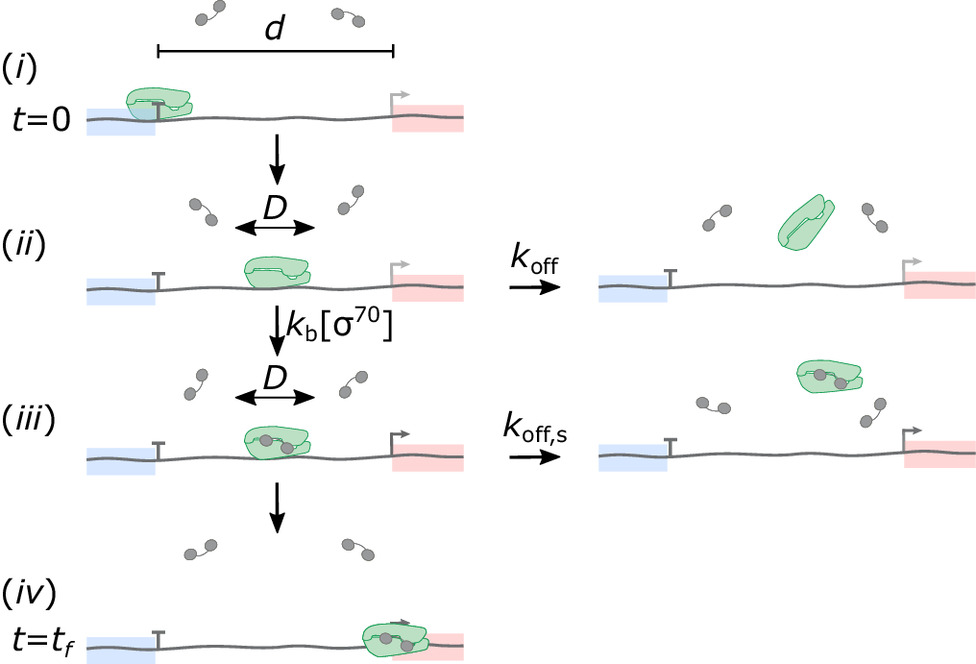
Transcription initiation is arguably the single most important process for the regulation of gene expression in all organisms.  In bacteria, it is a widely accepted dogma that regulated transcription initiation at a promoter sequence controls only the adjacent transcription unit (i.e., a gene or operon).  In contrast, this paper demonstrates the feasibility of a new mechanism by which production of multiple RNAs from nearby operons is coupled to the binding of an individual RNA polymerase molecule to a promoter.

pnas.2301402120fig01

The new mechanism was hypothesized based on the recent discovery in vitro of a post-termination state of the bacterial RNA polymerase in which the polymerase slides randomly on DNA after terminating transcription of one RNA and can reinitiate transcription on a nearby promoter, producing another RNA. Despite these observations, it was unclear whether the hypothesized mechanism could operate efficiently over the time and distance scales necessary to couple nearby operons in a bacterial genome in vivo. Now-graduated Ph.D. student Debora Tenenbaum and collaborators tested this idea by developing a mathematical theory based on a diffusion-to-capture mechanism. The theory quantitatively predicts the efficacy of operon coupling in terms of rate constants that were previously unknown but which the authors measured in single-molecule biophysics experiments. This combination of theory and experiment shows that the mechanism operates on the length and time scales needed to function in bacterial genomes. The results suggest a generalized mechanism that couples the transcription of nearby operons and breaks the paradigm that each binding of RNAP to DNA can produce at most one messenger RNA.

10.1073/pnas.2301402120
Tenenbaum D., et al. RNA polymerase sliding on DNA can couple the transcription of nearby bacterial operons. PNAS, 120, e2301402120 (2023)