
Transcription initiation is arguably the single most important process for the regulation of gene expression in all organisms. In bacteria, it is a widely accepted dogma that regulated transcription initiation at a promoter sequence controls only the adjacent transcription unit (i.e., a gene or operon). In contrast, this paper demonstrates the feasibility of a new mechanism by which production of multiple RNAs from nearby operons is coupled to the binding of an individual RNA polymerase molecule to a promoter.
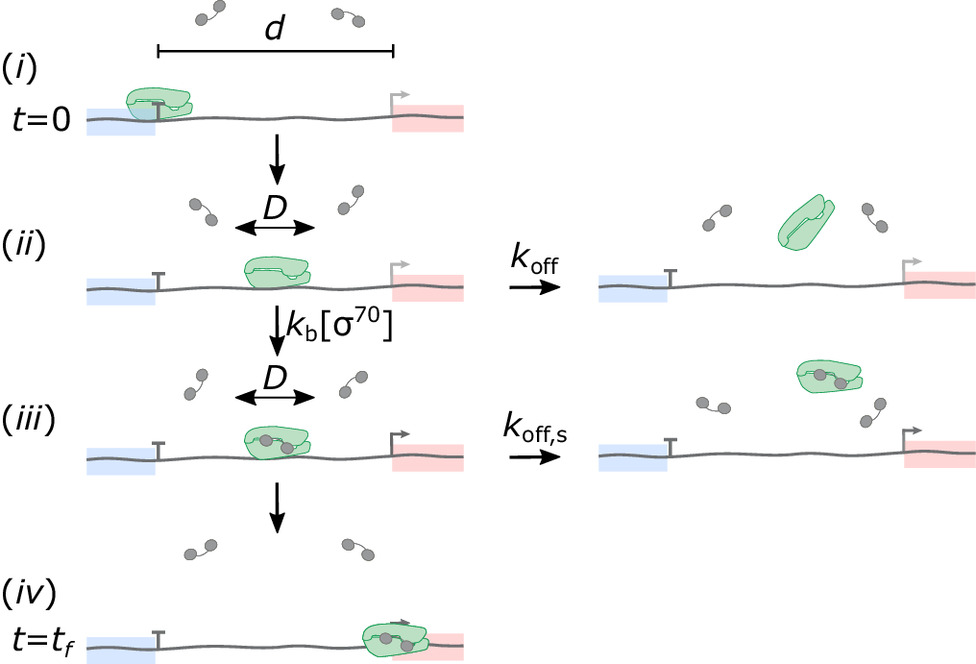
The new mechanism was hypothesized based on the recent discovery in vitro of a post-termination state of the bacterial RNA polymerase in which the polymerase slides randomly on DNA after terminating transcription of one RNA and can reinitiate transcription on a nearby promoter, producing another RNA. Despite these observations, it was unclear whether the hypothesized mechanism could operate efficiently over the time and distance scales necessary to couple nearby operons in a bacterial genome in vivo. Now-graduated Ph.D. student Debora Tenenbaum and collaborators tested this idea by developing a mathematical theory based on a diffusion-to-capture mechanism. The theory quantitatively predicts the efficacy of operon coupling in terms of rate constants that were previously unknown but which the authors measured in single-molecule biophysics experiments. This combination of theory and experiment shows that the mechanism operates on the length and time scales needed to function in bacterial genomes. The results suggest a generalized mechanism that couples the transcription of nearby operons and breaks the paradigm that each binding of RNAP to DNA can produce at most one messenger RNA.
10.1073/pnas.2301402120Tenenbaum D., et al. RNA polymerase sliding on DNA can couple the transcription of nearby bacterial operons. PNAS, 120, e2301402120 (2023)
 The Little Engine Shop